
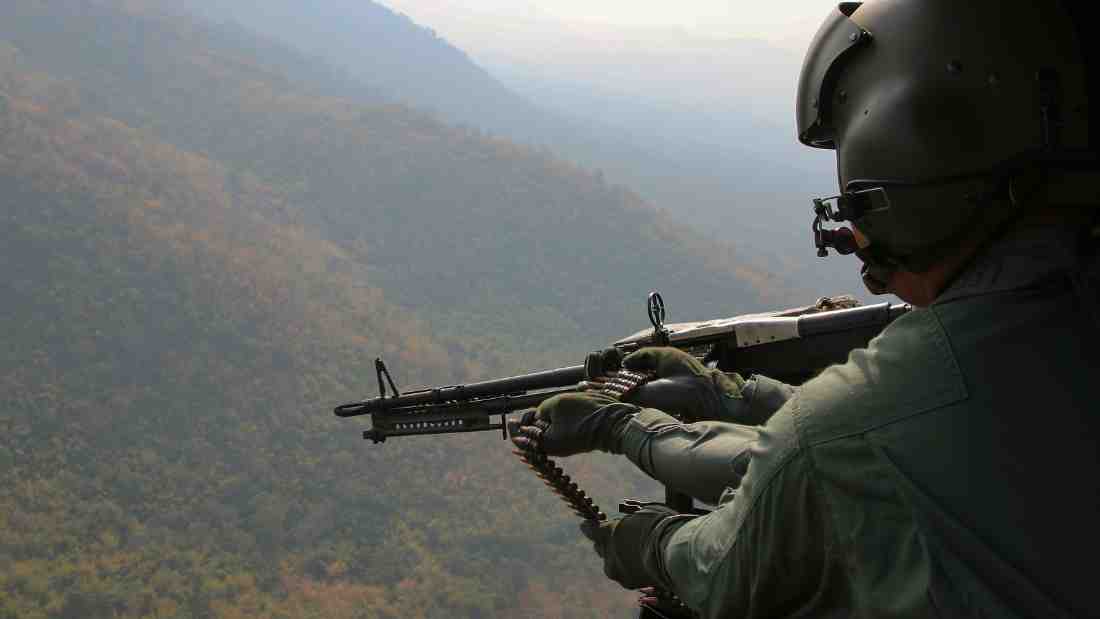
The thesis of the title statement suggests that the dominant objective behind contemporary wars is to accumulate economic and political commodities through the prolongation of conflict.
In order to engage with this view, this essay will use the term ‘contemporary wars’ to refer to conflict in the post-Cold War (1947-1991) period as it is employed by Kaldor (2013) in her discussion on the ‘New Wars’ theory, which will also be taken into account due to its practicality in contextualizing the wider conditions of the following argument.
This will centre around the complexities of war by considering other factors contributing to war, such as identity politics, in tandem with economic and political factors to inform a more holistic view. The arguments made will be supported by examples arising from Sudan’s civil resource-conflicts prior to 2011 (De Waal, 2019).
As Keen’s (2000) paper highlights, the theoretical dichotomy between the states of war and peace and the conditions under which they occur may not be as conducive as they tend to be portrayed.
Keen (2000) points to the possibility that the intention of ‘winning’ may not always be the prevalent desired outcome. This idea alludes to the ‘Greed versus Grievance’ debate which was brought to the forefront by Collier and Hoeffler (2004) whose empirical argument is skewed towards the suggestion that greed and the accumulation of goods is the dominant motivation for prolonged conflict.
Keen (2012) criticizes this view, maintaining that by accepting Collier and Hoeffler’s (2004) conclusion one risks missing the complex web of political grievances and factors of social inequality that may lead to violent conflicts.
Inserting Context into Conflict
In her book, Kaldor (2013) asserts that contemporary wars need to be conceptualised in a different manner than preceding wars due to the innovative, dispersed and intensified way in which the globalization process is evolving.
Communication technology have been both a channel through which communities come together, allowing individuals and communities to reinforce parts of their identity, and an operation of global homogenization where certain ideals of democracy and equality have been exported world-wide.
De Waal (2009) outlines the resulting attitudes that tend to result from engagements between African states and the international community including those exhibited during the boost in oil development.
Through his work De Waal (2009) conveys that negotiations that may prove fruitful in a certain areas having a democratic history, may not be as functional in the African region which is “organized according to a patrimonial marketplace, which operates according to socio-culturally determined rules” (p.99) “using kinship and patronage, and licensing proxies” (p.101, De Waal, 2009).
Furthermore, De Waal’s (2009) argument is effective in communicating the precarious nature of the “price of loyalty” (p.109) when working on peacebuilding projects within the region as this has both economic and political implications.
The interactions that influence the ruling and opposing group’s operations may be necessary to keep in mind.
Further to the above, Assal (2006) states that it is imperative that the international community comprehends the sociological and cultural factors at play when endeavouring to analyse the resource-based conflicts.
This may be so especially in Sudan since as De Waal (2009) implies that development operations that have failed to do so did not prove to be operational long-term.
During the advent of the millennium, the kleptocratic Sudanese government, spearheaded by dictator President Omar al-Bashir endorsed a development project where farms became increasingly mechanised (De Waal, 2019; Johnson 2016; Assal, 2006).
Assal (2006) focuses on the rising conflicts between nomad pastoralist tribes and historically farming tribes, the latter being tied to the land.
The differing lifestyles produce natural opposition due to travelling and possibly trespassing nature of the nomadic tribe whose grazing cattle could be environmentally detrimental to farmer tribal land.
Historically, Assal (2006) explains these disputes would be resolved by tribal chiefs but the increasing scarcity of land has decreased the parameters of negotiation.
Land dispossession and its privatization by the government left many, such as the African inhabitants of Darfur displaced and destitute (Johnson, 2016).
It is thus important to track the ways in which resource conflicts have morphed into identity politics highlighting the marginalisation of a specific ethnic group (Assal, 2006).
Interestingly, Johnson (2016) relates that much of the land that had become privatised by excluding these groupings were used as oilfields and leased to foreign capitalist for the gain of those in the ruling party and those on their payroll (De Waal, 2019).
These occurrences could fuel resentment and frustrations once an ethnic group is alienated from their homeland.
Inclusion and Exclusion
Similarly to Assal (2006), Wucherpfennig et al (2012) advocate that conflicts which may be linked to ethnicity and ethnic loyalty, need to be viewed in the context of the dominating institutional powers.
In their empirical paper, Wucherpfennig et al (2012) find that rather than ethnicity being the driving factor influencing the duration of contemporary wars or the intensity of a group’s commitment, it is actually the exclusion and inequalities experienced by a group that lead to long-term recruitment into a privatized military or rebel group leading to the prolongation of war.
Therefore it depends on the political injustices exerted by the ruling faction.
As Wucherpfennig et al (2012) explain, ethnic exclusion is a “political strategy” (p. 84) which aims to “secure their political, cultural, and economic interests by selectively excluding parts of the population from access to valuable political and economic goods on ethic grounds” (p.84).
Through this exclusion and possible expulsion of ethnic groups though displacement, such as that experienced by the Dinka, the Nuer and the Fur, (Johnson, 2016), the state would be able to create a political stronghold in their region, providing necessary services to those who form part of their allegiance and this thus acts as a form of population control.
The votes and popularity of the majority in the ruling group’s region is of great importance since this may allow the dominant group to gain legitimacy enabling them to welcome and control relief aid, as well as, long term development grants as had occurred in fact Sudan where these had been weaponised for economic and political gains (Johnson, 2016).
As Deng (2006) asserts, when lineage factors such as Arab-decent are used to bolster self-identification and citizenship, determining access to social welfare, it is necessary to try and investigate other institutional factors at play which, as in the case of Sudan may be excluding, a large group of indigenous and non-Arab individuals who, as a result, became ostracized from their ancestral land and lost their rights to statehood.
In fact, during this period, access to the lucrative oil trade, bolstered by competitive foreign investments, became particularly instrumental in funding the government’s operations at the expense of the livelihood of many groups that had been excluded (Johnson, 2016).
Contemporary War Economy and the Political Marketplace
As could be predicted through the above discussion, territorial rights are of extreme importance in the contemporary war economy as this is a determining factor in securing funds for their allies (Johnson, 2016).
In the case of Sudan, it is not only governmental powers who sought access to such rights but also rebel groups since, as Johnson (2016) relates, property rights, access to resources, the oil trade and access to aid were all connected, acting as both a provocation and prolongation of war.
This is because while legitimization could allow a group to gain access and divert relief convoys that may later be sold, there are also a number of economic benefits to the prolongation of war for opposing rebel groups such as looting, pillaging, asset transfer, demanding protection money and security recruitment (Johnson, 2016; Keen, 1998).
The privatisation of violence has been transformed into a lucrative business since former combatants or independent mercenaries could provide the manpower needed to sustain wars.
These combatants are rewarded with benefits gained through illicit manners and may have no connection to the existing war. In these cases, Collier and Hoeffler’s (2004) ‘greed’ thesis would be sustained since war would seemingly be protracted due to self-interest and increasing profit.
Wucherpfennig et al (2012) logical analysis of this act, however, seems to indicate otherwise, not only because of the grievances suffered because of ethnic exclusion is missing but also due to the non-existing connection of these actors to the cause of the conflict, thus increasing their possibility to desert the cause and allowing human resources to dwindle.
Kaldor (2013) recognises the power behind identity politics and the interactions they may bring to a contemporary war especially when placed on the globalised platform where groups vie for rights.
She also recognises the possible manipulation of this phenomenon which may be utilised by group leaders to mobilise troops and increase recruitment for their cause (Kaldor, 2013).
This may also be seen in the wider context and increase of possibility in buying group allegiances as since ethnic identities may be morphed (Wucherpfennig et al, 2012).
Conclusion
The aim of the above discussion is to demonstrate that whilst wars may seemingly be fought to amass economic and political assets as argued by scholars like Collier and Hoeffler (2004), they may actually be driven by other factors, particularly identity politics which dominate a big platform of the global conversation nowadays (Kaldor, 2013).
To examine this, it is important that critical practitioners always examine the institutional and socio-cultural context in which conflicts arise in order to gain a more vivid image of the hidden complexities of a war.
As has been suggested by Keen (2000), it may be useful to steer away from binary notions of war and peace since this notion seems to recognise the need for an outcome or the end to be realised in order for peace discussions and implementation of policies to be realised.
References
Assal, M., 2006. Sudan: Identity and conflict over natural resources. Development, 49(3), pp. 101-105.
Collier, P. and Hoeffler, A., 2004. Greed and grievance in civil war. Oxford Economic Papers, 56(4), pp. 563-595.
De Waal, A., 2009. Mission without end? Peacekeeping in the african political marketplace. International Affairs, 85(1), pp. 99–113.
De Waal, A., 2019. Sudan: A political marketplace framework analysis. Occasional Paper no. 19. London: World Peace Foundation and the Conflict Research Programme, London School of Economics and Political Science. Available from: http://eprints.lse.ac.uk/id/eprint/101291 [27/10/2023].
Deng, F. M., 2006. Sudan: A nation in turbulent search of itself. The Annals of the American Academy of Political and Social Science, 603, pp. 155-162.
Johnson, D. H., 2016. The war economy & the politics of relief. In: The Root Causes of Sudan’s Civil Wars: Old Wars and New Wars [Online]. 3rd ed. Suffolk: Boydell & Brewer, pp. 263-302. Available from: https://ebookcentral.proquest.com/lib/bath/detail.action?docID=4591814 [22/10/2023].
Kaldor, M., 2013. New and Old Wars: organised violence in a global era. 3rd ed. Cambridge: Polity Press.
Keen, D., 1998. The economic benefits of civil war. Adelphi Papers, 38(320), pp. 15-22.
Keen, D., 2000. War and peace: what’s the difference?. International Peacekeeping, 7(4), pp. 1-22.
Keen, D., 2012. Greed and grievance in civil war. International Affairs, 88(4), pp. 757-777.
Wucherpfennig, J., Metternich, N. W., Cederman, L. and Gleditsch, K., 2012. Ethnicity, the state, and the duration of civil war. World Politics, 64(1), pp. 79-115.

Hannah Cassar holds a Bachelor of Arts (Hons) in Anthropology from the University of Malta, and is currently pursuing a Master of Science in Humanitarianism, Conflict, and Development at the University of Bath.
She is a Research and Policy Officer with the Malta Further and Higher Education Authority, and also a council member of the Malta Anthropological Society, where she focuses on promoting research and awareness about anthropology, facilitating discussions and events that engage the public in anthropological topics and foster a greater appreciation for the discipline.