
This paper was first published in the Journal of Mediterranean Studies, Volume 3, Number 2, 1993, pp. 335-353. Published by Mediterranean Institute, University of Malta
In this paper I will be analysing the phenomenon of ghana (pronounced ‘ana’) in Maltese society. Ghana is the Maltese word for the (rather than ‘an ’) indigenous style of singing. However the word has come to be associated largely with three highly stylized genres, in particular with the genre of Spirtu Pront ( ‘quick spirit’), a ritualized, extemporized song-duel.
Ghana is generally regarded by all sectors of Maltese society as being ‘traditional folk-singing’, a remnant of an aboriginal, folkloric past.
I will be showing, however, that ghana is neither ‘traditional’, for over the years it has changed both stylistically and in content, nor mere ‘singing’ , for the competitive duelling it entails draws its impetus from and has repercussions for the perceived social status of the ghannejja ( ‘singers’; pronounced ‘anneyya’), who are practically all urban working class men.
Indeed as I shall try to demonstrate, ghana is not really ‘folklore’ at all— it is very much a phenomenon of and a reaction to the contemporary Maltese political situation. (in the broad sense of the term). If it is to be seen as ‘folk ’ at all it must be in the sense of ‘Volk ’ , a ghostly entity disembodied from the people who sing it.
Whilst the middle and upper classes tend to regard it as quaint folk-singing, indicative of the ‘sweetness of the people ’ in the past, which has been tainted by the partisan political use made of it by its present ‘low ’ practitioners, its working class practitioners have seized upon the attention awarded ghana by intellectuals to see it as being somehow coextensive with Maltese cultural identity, a pure entity which they are preserving despite the occasional lapse by an individual ghannej ( ‘singer’; pronounced ‘an nei’) which momentarily stains it.
By preserving ghana the ghannejja consciously see themselves as ‘guardians of folk lore’ and in this role use ghana as a vehicle for statements about cultural traits in Maltese society, or rather ‘conflicting identities in Maltese society and culture’ (Sant Cassia 1989: 164). In so doing they subvert the ‘official’ bourgeois categories of ‘outside ’ and ‘inside’ and set up their own.
Ghana is a particularly suitable object of study for political anthropologists. It enables one to study three inter-related topics.
The first is the political significance of certain rituals and how they integrate both the micro and macro levels o f politics . In most political analyses the observer has to concentrate on either the local level or the national one and only after doing that establish the connections between the two (c f ., for example, Loizo s 1975).
Unfortunately students o f Maltese politics have rarely given much attention to drawing the connections between these two levels of politics: scholars have either concentrated on the struggles featuring the two main political parties and the Church (e .g . Koster 1984; and Vassallo 1979), or else restricted their investigations to a local level (e .g . Boissevain 1965, 1980).
In ghana, however, the two levels are linked— personal, micro and national political issues are intertwined through the content o f the songs.
The singing ‘rituals’ integrate the ghannejja both on the local level, as they duel between themselves for honour and prestige, and with the wider society , as they comment on the contradictory features o f Maltese culture.
This issue is rendered even more interesting because of the ‘deception’ involved.
Whilst the singers appear to be utilizing a ‘traditional’ form of culture (and hence semi-patronized by official ideology), they are in fact utilizing a form which is far from traditional and which has evolved in form and content.
Hence we are dealing with an inverted form of politics dealt with by Bloch (1975 ), in that we have here a subversive form of political language in a ‘traditional’ guise rather than an inherently traditional form of rhetoric which legitimize s existing structures.
We cannot say that we are dealing with an invented tradition however, because the origins of ghana have not been established; if anything, earlier traces of it keep being discovered.
The second topic which ghana can illuminate is the symbolism o f Maltese politics.
Whereas Boissevain, the most notable observer of Maltese politics, tends to merely present symbols as though their meaning were self-evident, the ghannejja play upon the ambiguities of certain symbols (e .g . of literacy) in Maltese bourgeois ideology, thus reaffirming Cohen’s point (1974) that symbols are not self-referential.
Finally the phenomenon of ghana, by showing how ‘politics ’ is expressed and pursued through discourse, confirms once again the long established philosophical point that words do things (Austin 1960; Searle 1969).
In ghana, identities are staked in a virtuoso performance. This is done in two ways.
The theme of social origins, which is dominant in ghana, establishes identities by focusing on difference and the ‘essence’ o f Maltese-ness (cf. Herzfeld 1983; 1 1 -1 6 , 1987: 7 7 -9 4 ) .
However, in relating the categories o f ‘inside ’ and ‘outside’ to class differences, identities are related to social structure in an interesting twist to Leach’s argument (1 9 5 4 ) with regard to tribal identities.
Here, instead of having identities changing over a historical period of time (as with the Gumlao and Gumsa in Burma) we have a case where, because o f the language (in the sense of both ‘tongue’ and ‘rhetoric’) one uses, one may place oneself (or be placed !) ‘outside’ or ‘inside ’, ‘high’ or ‘low ’ in other words, it may not be just a matter o f codeswitching but one of different folk-models of society — obviously this is a matter requiring separate treatment and I will not be examining it here.
What is interesting is that the issues posed by the singers are in fact faced by the majority of the Maltese in their everyday life.
In a bilingual country where English has hierarchical connotations and Maltese egalitarian ones, choosing to speak English rather than Maltese, sprinkling one ’s Maltese with English words, or insisting on speaking Maltese when English would be more conventional, affects personal and social relationships.
But it affects the ghannej in a particularly acute way. For in the social drama that is ghana, he is engaging in a presentation of selfhood and manhood. And as Cohen has pointed out:
‘(S)ymbols and power relations, symbols and selfhood . . . are highly interrelated problems. The symbolic order and the power order are involved in the creation and recreation of selfhood . . . ’ (1974: 138)

The Different Genres of Ghana
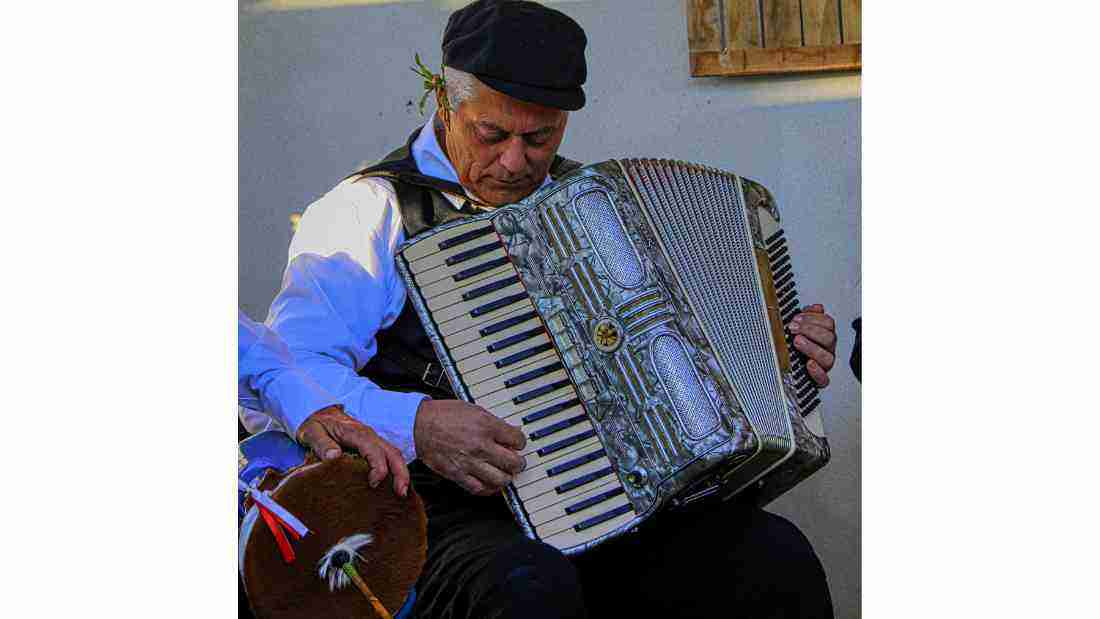
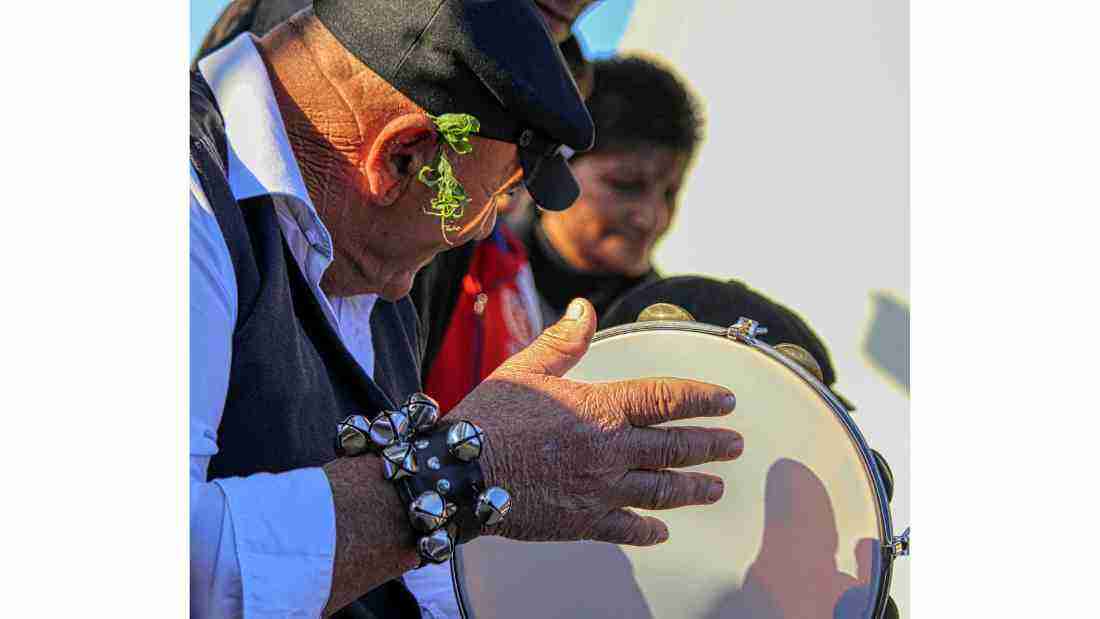
Strictly speaking, ghana is the generalized term for the indigenous Maltese folk-singing which consists of quatrains, ideally extemporized, following a rhyme scheme of a-b-c-b, and sung to traditional tunes, generally accompanied by a choice of guitars, accordion and various percussion instruments.
In the past, the singers were rural villagers and blue-collar workers,
‘the washer-woman, the soldier, the boatman, the milkman, the farmer, the fish-seller, the coachman, the lace-maker, the maid . . . when her mistress [was] not at home . . . ’ (Calabrito, 1930).
The songs themselves dealt with every facet of the social lives o f these people: birth, courtship, marriage, death, nature, suffering.
Although the songs were ideally extemporized however, in practice they were generally learnt ‘as one learnt church hymn s ’, by hearing other people sing them.
In fact, some quatrains were standard and flexible enough to be adapted to general kinds of situations.
However, the term ghana also came to refer to three types of singing, which was conducted in more specific contexts:
(a) La Bormliza,
(b) Fatt and
(c) Spirtu Pront.
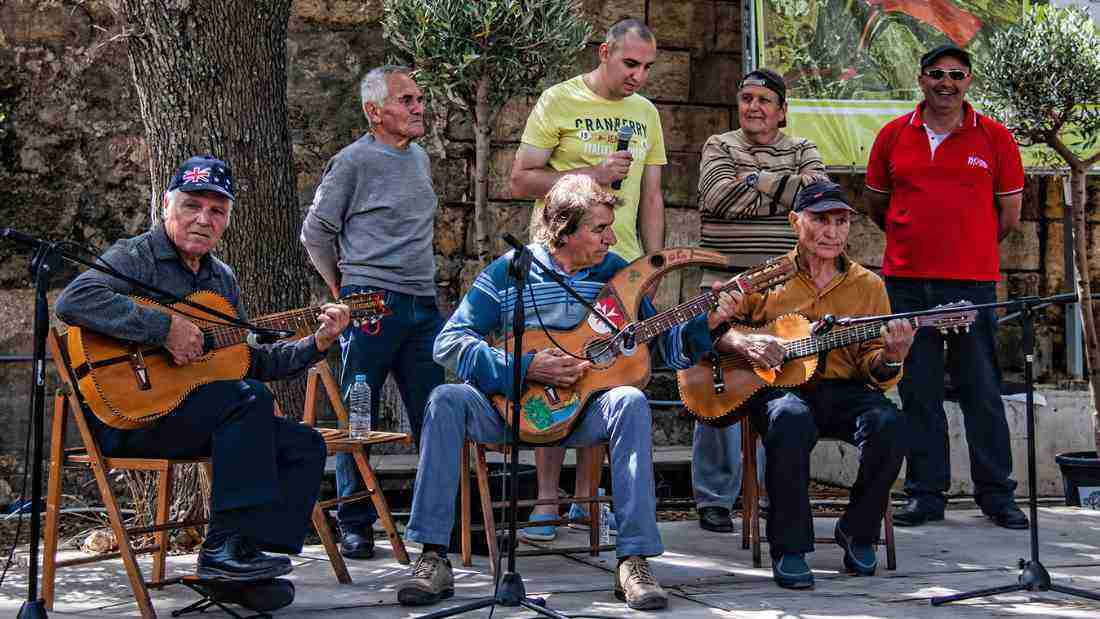
In all three genres, the singers are accompanied by three guitarists (two strumming a steady rhythm while the third improvises, along channelled lines, on a traditional tune in a sort o f emotional outburst in between one quatrain and another).
La Bormliza
La Bormliza (after the city o f Bormla) is an all but extinct genre o f ghana, and I will not be considering it in this article. It consists of four lines, with a final rhyming couplet.
It was sung by two singers, though it could also be sung solo and it could take one o f two forms: either a line scheme o f a-b-a-b-c-d, or one o f a-a-a-a-b-c, in both cases having in each singer sing every other line. The lines could be extemporised though they are usually standard.
The outstanding feature of La Bormliza is that the words are very drawn out, making it both very difficult to understand and difficult to sing.
In fact, it is also known as ‘ghana on a high pitch’ (ghana Fil-gholi), since this feature requires that men sing it in a female vocal register. For this reason it was sung to exhibit vocal prowess and mainly by women.
Women generally sang it together while doing communal housework, such as washing clothes in the village basin. The gradual but definite demise of the Bormliza is due to the fact that the social context which enabled it to flourish has now practically disappeared.
Many of the (potential) singers have been middle-classified: households are now usually neo-local, the family has been urbanised and women generally meet each other only when also in the company of men.
Fatt
This fate has not been shared by the second genre—Fatt ( ‘fact’; plural Fattijiet, pronounced ‘Fattijief ).
Fatt is a story narrated by one singer, usually the composer of the song. It can either relate a true story or a fictional one. In both cases the subject is traditionally a tragic one, although there are comic narratives (not referred to by any specific name) which deal with typical situations such as the relationship between man and mother-in-law.
There have been Fattijiet written about the theft of the Admiral’s payroll of £125,000 in 1948, the gruesome murder of a boy by his mother, and the tragic death o f a singer’s young cousin, for example.
In general the fictional Fattijiet have some understood moral, which reinforces the traditional values and which is meant for a general audience.
Some of the changes relating to the composition of a Fatt show the influence of literacy. Before World War II, many Fattijiet were obtained by buying booklets of printed ghana poems, which the semi-literate ghannej could read with some difficulty and memorise.
Illiterate ghannejja sometimes composed their own Fattijiet by dictating them to others. Also, popular songs were performed by singers other than the composer, even if the latter were a singer himself.
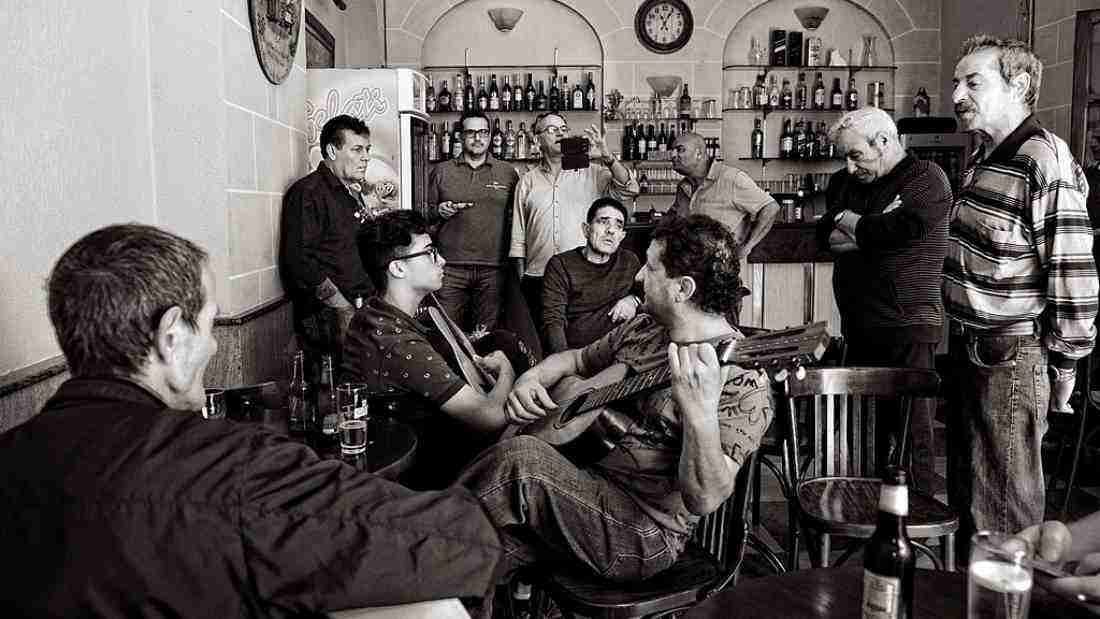
The songs were usually performed in wine-shops or at gatherings, such as feast days or village picnics.
Nowadays the main way of listening to a Fatt is either by obtaining a copy of it on tape, or by hearing it on the radio.
The biggest change however, and this shows the spreading of literacy, is that singers almost always sing their own songs now.
Spirtu Pront
It is the third genre, that of Spirtu Pront ( ’quick spirit/wit’) which is by far the most popular nowadays.
In fact, the term ghana is sometimes used to refer to it specifically, by both the ghannejja and the middle classes.
This essay will be dealing with Spirtu Pront and its social context mainly, and unless otherwise stated the term ghana will refer to it.
Spirtu Pront is essentially an extemporised song-duel between two men (almost no women sing it), each trying to best the other in argument. It is most typically held in a wine-shop or bar.
Generally however, two song-duels go on simultaneously, with the first singer matched against the third, and the second against the fourth. This gives each singer more time to think up a reply.
The subject of the argument may be selected beforehand, but it is usually ‘chosen ’ by the singers themselves during the course of the song, somewhere near the beginning.
They do this by feints, trying to provoke their opponent into taking up an argument or subject about which they are more knowledgeable, for once a subject is taken up, it cannot be changed without losing face.
The subject of the duel is often the capacity at ghana of the two singers, who try and ridicule each other by subtle insults which can poke fun at the opponent’s physical features, his (past) actions (though one should absolutely not lie) , as well as his arguments, while at the same time attempting to twist their opponent’s insults into compliments.
These bouts can be very witty since double-entendre— giving a compliment which is actually an insult— is prized.
The premium given to double-entendre also leads, even when the argument is very serious, to elaborate metaphors.
The reply and counter-reply must be given in the form o f a quatrain with a rhyme scheme o f a-b-c-b. The most awful mistake an ghannej can make is to not rhyme his quatrain for this is immediately noticeable.
Unusual rhymes are prized; however the effect of literacy can be seen in the disagreement between some ghannejja as to which is the more important— the rhyme in terms of pronunciation, or the matching of the last two letters of the last word in the second and fourth verses. Ideally, these words should both rhyme and end with the same two letters.
The duel lasts for an hour and the last volley on the part of each ghannej consists of two quatrains. This is known as the gadenza.
The best ghannejja are informally and by consensus deemed to form part of the ‘First Division ’ (the English phrase is used)— there are twelve such ghannejja in Malta at the moment.
What distinguishes them from the other ghannejja— though when talking about this particular subject I often got the impression that the only ‘real’ ghannejja were those belonging to the First Division— is their wit, knowledge and mercilessness in punishing a mistake on their opponent’s part.
‘Knowledge’ would here consist of knowledge of proverbs, archaic words and current affairs—anything that can floor an opponent, because not understanding a volley he would not be able to reply adequately.
The ghannejja consider themselves to be connoisseurs of ghana, appreciating it to an extent in which few members o f the ‘lay ’ audience (mostly made up of men) ever can.
Since the aficionados (listeners) do not sing their appreciation is considered dilettante.
The most generous estimate I was given regarding the proportion of aficionados who fully savoured ghana was three out of ten. Part of the reason for this low figure is that some duels may refer back to past encounters, sometimes even as far as twelve years back. Thus the aficionado must avidly follow developments in the various encounters.
However, the role of the aficionado is still significant in a small-scale society where much of the micro-political jousting hinges on reputation. The ghannejja depend upon the aficionados to decide for themselves as to who the winner of a particular bout was.
The verdict is not officially or openly passed; in fact clapping during an encounter is forbidden, though permitted at the end.
‘The people judge for themselves while we [the duellers] go and have a drink together.’
Thus, the audience is always a sort of participant (Sant Cassia 1989; 162 -163) .
The Evolution of Ghana
There is certainly a clear difference between the ghana sung today, which is sung by specialists in a particular setting, and the ghana still very much alive up till the end of World War II at least, which was the domain of no one in particular, being sung by most blue-collar workers as they went about their daily chores.
Ghana today (associated almost exclusively with Spirtu Pront) is much more stylized and has also changed in content.
Even the music is different; the ‘ghana of the villages ’ (which for lack of a better term is how I shall refer to the ghana of the past) utilized not only guitars but also the accordion and various percussion instruments, while ghana todays uses only guitars, which again tend to be played by specialists whose music is much more elaborate than it was forty or fifty years ago.
Perhaps the most interesting feature about the history of ghana is that there are two versions of it.
The first was given largely by middle-class people, but also by a number of working-class informants who were not ghannejja themselves (though some were aficionados).
This interpretation goes that ghana in the past was ‘good ’, reflecting ‘the sweetness of the people (peasants)’ as one middle-class informant put it, but it has now been ‘corrupted’ by the present singers who have mixed politics with it, and who in fact have often quarrelled seriously among themselves because o f politics .
The second version is that of the ghannejja themselves and it is the reverse of the first.
They see the ‘old ghana’ as having been characterized by brawls, whereas now it is ‘more elevated, like poetry’ .
The two ‘histories’ may be placed side by side thus:
outsiders: ‘sweet ’ —————-‘corrupted’/politics
practitioners: brawls —————- ‘elevated ’/’poetry ’
It is not something novel for something deemed to be ‘folk-singing’ to be variously regarded; for example, Greek rebetika music has also been labelled in diverse and contradictory ways (c f . Gauntlett, 1983).
However I believe that here there is an additional reason behind this. I suggest that while the two historical versions are referring to the same ghana when talking of the present, they are referring to different phenomena when talking about the past.
The outsiders are referring to the ghana that used to be sung to accompany work, the spontaneous though not always accurately rhymed ‘expression o f the people ’.
The ghannejja, however, are referring to the ghana that used to be sung mainly at night, certainly during the hours of recreation, by young men.
The ghannejja used to compete with each other to see who was the most quick-witted in a song-duel which consisted of an exchange of often very direct insults. These singing sessions often broke out into fist- fights and the police had instructions to break up sessions whenever they came across them.
Of course, there is some overlap between these two type of ghana, notably in the past tradition of going to sing beneath a young nubile woman’s bedroom window.
But even here, the main difference between the two is clear: whereas a serious suitor would have been more likely to sing a standard quatrain, his main objective being to communicate his interest as well as to show of f his voice, an ghannej would have been more likely to extemporise a cheeky quatrain, or even a downright insult.
The main object of the first type of ghana was to communicate, the importance being placed on the voice rather than originality, while with the second type bravado was what mattered.
While a different past is being referred to in the two versions of the history of ghana, the present they refer to is Spirtu Pront, whose predecessor, it is easy to see, is that competitive ghana of the men who used to congregate at night.
This explains why women, who used to sing when doing their household chores, do not participate in ghana nowadays. Their singing was tied to a way of life that has now disappeared, whereas ghana was always concerned with issues that traditionally, in the Mediterranean, preoccupy men (e.g. honour). It remains to be shown why it was that the competitive ghana came to be equated with ghana in general, and how it evolved to its present form.
The pivotal point in the story of the transformation of ghana, both in the sense of how it came to be associated with one genre and in the sense of how that very genre changed in content and form, is the first official ghana competition held on the national feast day o f St. Peter and St. Paul (L-Imnarja) in 1953, which was organized by a folklorist, G. Cassar Pullicino.
What I suggest happened was that most o f the men who came forward to compete were in fact men who were already used to compete amongst themselves through ghana; and since this event, being the first time Maltese officialdom showed an interest in ghana, effectively converted ghana into ‘folklore’, ghana became associated with the Spirtu Pront genre.
It was essentially the form o f ‘hijacking’ that Weber describes in connection with messages of redemption, in speaking of how the message is redefined decisively when the main social class of believers changes (1969:22) .
Fixing a date for such a major change of course disregards the fact that some changes had been going on before this date. Thus, ghana had been transmitted on the wireless since 1935 while a number o f records of ghana were also cut in the thirties.
However 1953 was the decisive date. As one ghannej told me,
‘it was after the Imnarja competition that the police allowed us to sing in public places .’
And it could be added that it was after 1953 that the ghannejja were in some respects welcome to sing. They became the focus of interest of some anthropologists, sang at Labour Party rallies, and by the seventies were asked to perform in hotels and were sent abroad by the government to participate in folklore exchanges.
The highlight must have come with the ‘Freedom Day ’ celebrations o f 1979 when the ghannejja performed at a cultural evening held at the Manoel Theatre, the ‘inner sanctum’ of Maltese theatre- and operagoers.
The 1953 competition also affected ghana vis -a-vis content and form.
The content changed because the ghannejja now saw themselves as representatives of Maltese tradition and this role encouraged them to sing more on social issues.
The form changed because the ghannejja adopted many of the competition rules. The relevant rules were these: the ghannejja had to stick to a subject selected beforehand otherwise points were lost, as also happened if mistakes in rhyming occurred. There was also a time-limit set on each bout.
The ghannejja embraced these rules. Sticking to the subject became very prized, even if it meant singing just about a bottle of wine (a popular example with my informants): rhyming was made essential; and they limited their own bouts to one hour, holding another after that if necessary.
Around this time the idea of signalling the end of the bout by the gadenza— two quatrains rather than one— was introduced, while increasing emphasis was made on double-entendre, as direct insults broke up the community o f ghannejja (Herndon 1971: 154 -155 ) , and ‘lowered’ ghana in the eyes of outsiders.
Other major changes were caused by the introduction o f the tape recorder in the late fifties. Easy or repeated rhymes were now quickly found by aficionados and the beginning of the song became more stylized with singers stating who was singing, where and when, in order to distinguish one tape from another.
The availablility of cassettes also meant that emigrant ghannejja could dispense with the necessity of having a guitarist playing by having a tape o f the music sent to them.
Finally, the ghannejja also began to hold ‘public’ evenings of their own, usually at Labour Party clubs.
It is the association o f the ghannejja with the Labour Party that more than anything else makes the greater part o f the middle class see them as having ‘corrupted’ ghana.
For with the interest in folklore that arose after World War II, there was also a change in the way the working classes were regarded. They were no longer called ‘low’ but ‘the little people’ when talked about in the past or in the abstract.
This was a concomitant tendency to the very urban propensity, also present in Malta, to associate ‘tradition’ with the countryside. Thus the ghannejja were regarded as quaint when they sang in national festivals, in a showcase so to speak, but rather rattled the upper classes when they did not conform to the idyllic mould.
Thus ghana is a rather disembodied entity to the upper classes, pure in its pristine self, but corrupted by its practitioners.
The ghannejja also have this notion however, despite their seeing themselves as having improved the level of singing. For brawlers are chastised as ‘lowering’ ghana and are said not to be ‘true’ ghannejja.
There is also the semi-mythological notion that ‘corruption’ set in when ghannejja began asking to be paid for singing. Not only money but also technology played its part in corruption, for the introduction o f the tape-recorder meant that outwittal at the hands o f another ghannej was permanently recorded and circulated.
This made some ghannejja try to win at all costs, resorting to directly insulting the ghannej and even his family if necessary.
Hence ghana is no longer seen as a practice rooted in their lives but rather something which has been given to them, unworthy though they may at times be, to keep alive.
Although in actual fact the historical ghannejja were brawlers, by keeping ghana undefiled by such incidents, as well as by having raised the standard of singing, the ghannejja feel that they are more genuine singers than their historical predecessors.
Thus, for the ghannejja ghana is an independent, disembodied entity too.
Ghana as ritual
Having traced the evolution of ghana as being the course taken by a very broad genre of popular song as it came to be associated with a specific, highly formalized genre and a specific group o f practitioners, it is pertinent to ask whether ghana has become
a ritual.
Utilizing insights gleaned from Van Gennep (1909), Victor Turner (1967), Leach (1976) and Bloch (1986), I shall try to demonstrate that ghana is a ritual in the sense that:
(a) it is highly formalized and patterned;
(b) the singers are removed from society and are believed to be ‘inspired’;
(c) (i) it is a ritual o f competition between singers as social personalities, and (ii) a ritual o f inversal for the ghannejja as a ‘class’:
(d) the audience participates in a very substantial way— it is not only an observer but also forms part of the ‘content’ of the songs.
Ghana is certainly encapsulated from ordinary social life. Tensions between individuals that exist outside the ghana context are not dragged into the performance.
Whenever a fact having to do with ordinary social life is mentioned, it is done only to score ‘points’. Thus, while the ghannejja do not sing to resolve, say, disputes over land, an ghannejja might mention in song that his opponent has neglected to pay his electricity bill.
Indeed, the ghannejja are not bound together by anything other than ghana (although a few happen to be related through marriage). If an ghannej had to stop singing— as some do for their first few married years— he would cut himself off from the rest of the ghannejja.
Ghana is also marked off from the normal flow o f life in that there are several
unwritten rules or conventions governing the session itself that severely limit any spontaneity, barring, of course, the actual content of the songs.
Clapping is frowned upon and quickly censured on the rare occasions on which it does occur, and it is unthinkable that an aficionado would suggest a rhyme or reply to an ghannej; occasionally this happens, the story goes, and then the session is likely to end in a brawl (though I was never told of a specific instance).
The only spontaneity the audience is permitted is to laugh if a riposte is particularly witty. The exception here explains the rule: no explicit support should be shown towards any ghannej while he is singing (although some aficionados are known to be the ‘supporters’ of a particular ghannej); laughing is permitted because it downplays the tension of the event by stressing its ostensible joking character.
That there is or can be a great amount o f tension present is indubitable though. Once, a visiting ghannej from Australia, Salvu ‘l-Kalora’, was singing opposite ‘Superstar’ .
Although they are now on good terms it was well known that they had engaged in a particularly bitter and vicious quarrel a few years ago. When the session was drawing to a close and each ghannej had sung his gadenza (the concluding eight-verse riposte), ‘Kalora’ burst into another gadenza.
The spectators drew in a quick breath, thinking that he wanted to give ‘Superstar’ an extra blow , and only relaxed when ‘Kalora’, in the gadenza itself, excused himself with the audience and said he was only doing this to ask the oldest ghannej who was present, Pawlu Seychell, if he (Pawlu) would do him the honour of singing with him.
Other conventions that govern the singing itself also serve to ‘encapsulate’ ghana. In fact, there is a sense in which they could be seen as dividing the singing bout itself into pre-liminal, liminal and post-liminal stages.
Thus, the first quatrains of the singers are usually taken up by telling who is singing, where and when; often the guitarists are also included. This convention was instigated with the advent of the tape-recorder, where the circulation of tape-recordings of several sessions necessitated the easy identification of a particular session.
But this convention can be seen as easing in the start o f the bout, especially when one considers that during these first quatrains the audience is sometimes reminded to keep quiet. Indeed, I have only seen the audience being addressed directly at the beginning or the end of the session, but not during the ‘liminal’ stage— the main fight itself.’
Finally, this convention of ‘easing into ’ a bout is strong enough that if a singer ‘barges’ into a fight with his first quatrain, he is seen as being particularly aggressive and possibly even a show-off.
Strong shades o f a liminal state can be perceived in the main part of the bout itself.
First, the themes themselves are dramatic and grave (even if dealt with wittily): they may be personal honour, reflections on social values, or political (in the narrow sense of the word).
Second, the language used is not one that is used in ordinary social intercourse; it is high-flown, using elaborate metaphors and formalistic phrases, as well as (depending on the ghannej) occasionally outrightly self-righteous.
One of the most common metaphors is that comparing the two singers with race-horses while sprinkling quatrains with proverbs is prized for it adds a moralistic tone.
Finally, some phrases are formulaic, the most common being ‘I am an ghannej and so are you ”, and ‘I love(d) you and you love(d ) me ’. Such formulaic phrases are common enough in oral poetry (Ong 1982; Finnegan 1981).
Here the phrases may either be used ironically or else strategically, to manipulate the counterpart’s response.
Their ironic deployment is obvious: such phrases usually precede an insult. It is the second use, the strategic manipulation of the opposite number’s response, that is the more interesting, for it is reminiscent o f Bloch’s description of the use of formalised language for social control, especially to rule out disagreement (1975: 16).
Here, Merina elders, for example (for similar techniques are also used by the Tikopian Maru, Tswana chiefs and New Guinea Highlanders among others), are deemed to use highly formalised language because of its lack of specificity as well as its being associated with tradition.
I have observed a similar technique used by the ghannejja, though the language used was not so restricted.
A particular example is relevant here. In one situation one singer was trying to placate the other, who was nursing a grievance done to him by a third party. On this occasion the parties interested in burying the matter tended to use formulaic language as well as urging the grieved singer to ‘forgive and forget’ by using stock sayings as well as appeals to the singer’s Christian charity.
Thus, in successive quatrains, the first singer (Salvu T-Kalora’) urged his companion (Pawlu Seychell) to follow Catholic Catechism ( ‘Duttrina’), to forgive as all Christians do, and to remember that ‘one should not act like the Mafia’, harbouring grudges, but have a pure heart ready for the Day of Judgement. Under this sort o f pressure, the aggrieved party must relent because otherwise the audience would deem him to be flouting traditionally held mores.
He can only resist by saying that the grievance was far too big to be easy to forgive, as indeed another singer did in a second case. Yet this singer, too, relented after the session was over and drank with the ghannej he held guilty of defaming him eleven years before.
Thus the ‘liminal’ state consists o f the two ghannejja carrying on a debate in which the ritualised atmosphere permits both jokes at the other’s expense and highly self-righteous language which in normal social intercourse would not go down very well.
However, the sanctimonious language tends to fade away or be outrightly reversed during the gadenza. Thus, during a duel one singer chastised another for boasting that as a government employee he did not work for his money, calling him a social parasite in the process; however, in the gadenza the former slyly admitted that he wished he was granted the grace of being in the latter’s position.
Also, the insults hurled during the duel are normally disowned. It is usual in the gadenza for ghannejja to refer to the insults exchanged as ‘joking between friends’. Hence the gadenza, the marker of the transition back to normal discourse, may be regarded as a sort of post-liminal phase.
The ritualistic quality of ghana is enhanced by other features.
Firstly, as sung nowadays, a session has a pre-determined length—approximately one hour.
Secondly, stating the names of the singers and the venue and date of the session gives the event a cosmic dimension. This is especially so when the date is given, for in Maltese the year must be uttered in word and not number form. Thus the singer states, say, ( if the year were 1989): ‘The year is nineteen hundred and eighty-nine, the month x, the day y ’ (instead o f ‘nineteen eighty-nine . . . ’).
Paradoxically therefore, stating the date gives a timeless quality by putting the event on a par with other important historical dates. This tendency to connect disparate events together is further accentuated by the music, which although improvised follows a traditional tune.
It is this linking which gives tragic Fattijiet (the non-extemporized ghana which either relate a true or fictitious tale, generally tragic semi-mythological stature— for each story thus seems to be linked to all others that are played to the same tune thematically, as well as musically.
In this respect ghana can also serve to mythologise history. The best example of this is the Fatt called ‘Mintoff Story’, which is the biography of the charismatic former Labour Party leader and Prime Minister Dorn Mintoff,which is played to one of the most moving renditions o f a traditional tragic tune— Mintoff’s political vicissitudes thus gain epic proportions.
The mythological element is also present in a more substantial sense. As Sant Cassia points out, ‘ghana probably represents a language closer to “myth” than to poetry’ (1989: 164). This is because of the effect the riposte and counter-riposte, together with the value attached to sticking to the ‘Subject’, leads to the ‘structure’ of the duel becoming evident only through repeated opposition.
It is significant in this respect that the ‘true’ ghannej is regarded as ‘a genius, a poet’ . His art is a ‘gift from God, a vocation’— this was the very first thing my first interviewee Bamboccu (and it was repeated to me many times by other people thereafter) told me, an ‘outsider’.
For ghana is more than a form of competition between the ghannejja: it also creates and expresses competition within this social group vis-à-vis the wider society . At its best ghana is an epiphany of Divine Grace, as one listens and watches the ghannej ‘build his Subject’ , edifying the audience and, at least by implication, making statements about the central values o f Maltese society as well as about Maltese identity.
This is what draws the audience in, makes it a participant and creates a community.
Perhaps also, it is this that made an informant tell me that ghana ‘bewitches you, it gives you gooseflesh ’.
Ghana, honour and ‘folklore’
In this section I discuss why an ‘epiphany of Grace’ is so significant to all present at an ghana session . This involves a consideration of what it means to be a ‘real’ ghannej.
Herndon has written:
‘Several singers told me that a singer must be a genius, possessed of great courage, wit, intelligence, willingness to work, and a bit of cunning’ (1971: 237).
Even if we discount a tendency to wax eloquently with a stranger about their hobbyhorse, it is easy to se e that the qualities listed here by the ghannejja are the qualities they need in their social milieu to earn reputation and defend their honour.
For the ‘road of ghana’ is an arduous one: the ghannej must be alert at all times, parrying slights and nimbly felling blows masked as compliments.
In fact, distinguishing oneself as an ghannej and building for oneself a reputation of nemo me impune lacessit (no man may harm me with impunity—cf . Pitt-Rivers 1977:5) are two parallel endeavours.
The nexus between the two is the notion of male identity and it is this— the fact that ghana is concerned with the construction of male identity on one level— that more than anything else explains why women ghannejja are rare. Even then, these women are renowned only for their ability to rhyme words wittily, and they never quite make it to ‘First Division’ status.
One leading singer (admittedly a formalist) once complained to me that a certain other ‘First Division’ singer (who is somewhat of an anarchist) tended to trivialise everything; he ‘lowered ghana’ because he sang ‘women ’s ghana’.
Thus, ghana also helps in reifying traditional Mediterranean gender roles. Only men are ghannejja because it is men who are concerned with innovation and readiness to act (the specific name for the extemporised ghana is Spirtu Proni— ‘quick-spirit’) and not women who are associated with listening and maintenance of tradition.
Hence ghana is sung predominantly in wine-bars, whereas in the past, when women did sing, they sang traditional quatrains to while away their household chores. Again, women sometimes relayed gossip to each other by singing (obviously not in the presence of the subject o f the conversation) whereas ghana is the exact reverse o f gossip: ‘[Gossip . . . is often explicit, private and concealed . . . ghana by contrast, is implicit, public and exposed.’ (Sant Cassia 1989: 155).
Ghana is sometimes also directly involved in reifying traditional gender roles, by being a discourse by men on women. This is especially so with the Fattijiet, the prewritten songs which are aimed at the whole family, and which generally reach it via the radio.
A large proportion o f the Fattijiet I have listened to deal with women, in one role or another. Thus the singer can rail against new dress fashions and women ’s loss of shame in this connection (quite a common theme).
Two fictional stories also dealt with the mother-child relationship: one told of a young boy who was kicked out of his home by his single mother so that she could live with a man; the other concerned the tragedy of a boy who, disobeying his mother, went to help make fireworks and died in an explosion.
The songs can also be humorous where warranted, dealing, for example, with a gluttonous mother-in-law or with women’s ‘foibles ’, such as diet.
However, ghana is not only the province o f the working class male social world, but also one of the means to enter it.
Many men were first introduced to ghana as young boys, having been taken along to the wine-bar by their father or uncle. In fact it is significant that many ghannejja were ‘apprenticed’ to uncles or godfather figures rather than their fathers. This is probably because such a relationship is more akin to the egalitarian relationship to be found in the wine-bar milieu.
Thus, in a Fatt lamenting the tragic death of a young cousin of his, one ghannej talks of how he used to teach his cousin to sing in conjunction with how he used to give him cigarettes secretly.
Again, while spiritual kinship is often invoked during duels, the older singer is usually called ‘teacher’ or ‘grandfather’, not ‘father’.
The ghannejja certainly form a community, the creation o f which is undoubtedly helped by the general use of nicknames to refer to ghannejja. As has been suggested by Pitt-Rivers (1954: 160 – 177) , nicknames serve to define ‘insiders’ against ‘outsiders’.
But although, especially after a bout, there is much embracing and fond manhandling as well as drinking together, this community is not quite like the ‘communitas’ postulated by Turner (1969) nor does the joking help to create the community in quite the same way as suggested by Douglas (1975 :90 -114) .
Rather the community is created by aggression (cf. Gilmore, 1987) or more accurately, the ghannejja ‘joke to make friends’, in a manner analogous to the Glendiots’ ‘stealing to make friends’ (Herzfeld 1985: 1 6 3 -2 0 3 ) . If an ghannej is known to be a ‘good joker’ (i.e. capable o f slapping you with a very witty insult), it is best to remain on his good side.
But the joking and teasing also has the function of creating ‘joking relationships’, where mock conflicts are staged in order to avoid real ones (cf. Radcliffe-Brown 1940, 1949).
For since honour is at stake, with the concomitant duty to defend it if challenged, the ghannejja are very prickly individuals. The notion of honour is very similar to that typically found throughout the Mediterranean and which has already been excellently analysed by anthropologists such as Bourdieu (1979: 95 -132 ) and Pitt-Rivers (1977).
Its most prominent characteristic, apart from its need to be defended, is that it can in effect only be challenged by an equal, and consequently one should not lower oneself by challenging an inferior.
Thus, First Division ghannejja are often reluctant to sing with singers of a lower calibre, some of whom sometimes demand to sing opposite them.
But generally the top ghannejja relent, privately saying that they did not want to make the other singer lose face by refusing to sing with them. Even then, they feel that they have to restrain themselves and not ‘attack’ the weaker singer head-on.
Individual ghannejja fall out very easily with one another, the breach in the relationship sometimes lasting for several years. The constant vigilance over one ’s good name is indicated by the fact that the phrase ‘he sang about you ’ can only mean ‘he insulted you’ (at a session which was not attended by the victim of the assault), and if ‘he sang about your family ’then the repercussions will be very serious.
Then the reciprocal exchanges of gifts in the form of insults/compliments (which refract off each other, for ‘insulting’ somebody can be a compliment— he is close enough to the singer to be teased) and drinks, which serve to create community (Hart 1986:648 ), are replaced by the ‘reciprocal exchange’ of tapes which directly (as opposed to the double-entendre favoured in duels) attack the other’s honour by uncovering ‘facts’ about his family (both wife and ancestors).
This type of feuding is frowned upon and called ‘dirt’. The ghannej who indulged in it might himself later admit that he stooped ‘low ’, but add that he couldn’t help it—he had to defend his honour, although in another sense he lost face.
It is striking that most ghannejja do not think of refusing to counter ‘dirty’ tapes, on the pretext that it is beneath them (and hence simultaneously casting a dark shadow on the attacker).
This is probably because they are caught in a tension which pervades the whole of ghana. This is that amongst themselves the ghannejja must defend their honour at all costs while at the same time knowing that following this code to the hilt will give ghana a bad name with ‘outsiders’.
This tension is also reflected in how among themselves the ghannejja attempt to distance themselves from their colleagues by becoming virtuosos, while in the face of ‘outsiders’ they maintain a façade of unity.
Thus, at the beginning o f a session held in my honour, one singer told the others to restrain themselves; he did not want a ‘war’ because this tape was ‘going to England’. This unity must be kept because they see themselves as ‘guardians’ of Maltese folklore.
Intellectuals are interested in what they do, the professional classes acknowledge that ghana is an indigenous phenomenon, while the government occasionally sends them abroad on a folklore exchange tour.
For them, the phrase ‘Maltese Folklore’ is synonymous with ‘true Maltese cultural identity’, and it is they who are helping to keep it alive in the face o f cultural importations, and the slavish imitation of foreigners by some of the middle class Maltese, most of whom look down upon ghana as being low class.
This is why the predominant metaphors used are images picked from activities
that they construe to have been constitutive o f traditional Maltese life, such as horse racing and farming (and some of these activities are actually constitutive of their own lives).
This is also what prompted one ghannej to tell me that ‘school’ was useful to teach one ‘old (Maltese) words’, (i.e. archaic), a striking inversal of the Maltese middle class attitude to education which is to facilitate social mobility and hence to internationalise oneself and one’s vocabulary.
The images used are expressing the recurrent themes of singing ability, and social origins, both of the Maltese people and of the ghannejja.
It is this last ambiguity, together with the ghannejja’s seeing themselves as ‘guardians of folklore ’ which enables ghana to act as a voice of largely illiterate working class men marginalised in a highly bureaucratic and centralised society.
Through this voice they express their partisan political beliefs as well as create a discourse about and through Maltese cultural identities.
The most obvious way in which they do this is when they voice their partisan political beliefs. Here ghana, a traditional genre, is used as a song of reactionary protest. Thus, in the sixties a Fatt was sung over the radio commenting on the mini-skirt.
However, the song was also about the right-wing Nationalist government of the time, the principal message being that the ‘chance wind of fate could ruin its semblance of propriety’ (Herndon 1971: 3 12).
Yet although it was a right-wing government that was being criticised, the protest was still a reactionary one: members of the Nationalist government were at the time accused of corruption and speculation in the sale of land, especially to foreigners.
Thus the ghannejja were representing the ‘Nation ’s interest’ in protesting, especially so since they were the ‘guardians of folk lore’, representatives o f ‘true Malteseness ’, while the upper class elite that was governing the country was an ‘outsider’, in connivance with foreigners, exploiting the ‘People ’.
These populist sentiments come out very clearly in other Fattijiet, particularly in the Fan ‘Mintoff Story’, where the socialist leader’s enemies are explicitly linked with colonial interests.
Analogous allegorical Fattijiet were also sung about the institutional (Catholic) Church, which was depicted as taking the side o f the rich against that o f the poor. Although these Fattijiet slipped through the hands o f the radio censors, middle class professionals who missed the allegorical meanings, it is clear that an overt position was taken by the ghannejja in these songs.
The interesting feature about their statements on Maltese cultural identities however, is that no such overt position is generally taken. The ghannejja are content to wittily expose contradictions in Maltese society, approaching a subject from many angles, subverting official categories of high class literacy and low class illiteracy, outside and inside, hierarchy and egalitarianism, sometimes ironically at their own expense.
The principal way in which they achieve this is by their strategic use o f the Maltese and English languages. Malta is a bilingual society, having English as its official second language, and it is well documented that in such societies the different languages tend to be attributed different statuses (c f., for example, Tanner 1972).
Thus, one ghannej sang about ‘The Language o f the Well-Mannered’ in which a middle-class mother (clearly from a particular area where Maltese is snubbed in favour of English) talks to her son in ‘Anglo-Maltese’, urging him to wake up and go to school so that he will be able to get a good job later in life and not a ‘low ’ one.
At least half the song is sung in English , showing how a supposedly ‘ignorant’ singer knows the language while simultaneously showing how the ‘educated’ massacre both English and Maltese. Or else, while singing in a wine-bar an ghannej might try and goad another into singing with him by addressing him with the English version o f his name— ‘Michael’ instead o f ‘Kilin ’ as everybody knows him.
This is easily recognizable as what in sociolinguistics is known as ‘codeswitching’, which as J. B. Pride has suggested, following Barth, is transactionally determined (1979).
Here, being called ‘Michael’ is to be made an ‘outsider’ , middle-class, not an ghannej at all. There is also an implied subtle inversion o f usual hierarchies: the Tow’ class o f the ghannejja is made to seem superior.
But the barriers are not always raised to exclude: they can also be lowered to include ‘outsiders’ while simultaneously acknowledging the differences that exist between the ‘insiders’ and ‘outsiders’.
That inclusion is usually achieved through the use of the Maltese language adds yet another discourse: that about the Maltese language itself as an egalitarian language.
An example which illustrates all this is the following advice given by ‘Bamboccu’ to ‘Folfol ’:
And Folfol pay attention
And exercise your mind a lot
O because Ranier our friend
Is taking you to University.
However, the most ambitious piece of subversion the ghannejja undertake lies in their very singing. An ghannej was expressing a widely held view when he told me:
‘The ghannej has in his mind a certain supernatural intelligence . . . We ourselves don’t believe that we can do this [sing] , . . . This is why the ghannej beats the astronaut, the priest, the lawyer, the doctor; because you can learn how to become one o f these, but you must be born an ghannej.’
What is subverted here is not the claim of the bourgeoisie to be educated, but rather that to be educated is better. For it is in being a true ghannej that one goees beyond is reactionary protest and voices true dissent from bourgeois ideology.
Dissent lies in being ‘a genius, a poet’, capable o f uttering lofty thoughts while being ‘low ’. It overturns the bourgeois idea of literacy = knowledge because the uneducated ghannej, called by God, might be said to be in one sense the Incarnation of Knowledge.
For this reason, to se e a true ghannej sing is to witness an epiphany of Grace. All this cannot but recall to mind Gellner’s discussion o f Muslim saints and baraka (e .g . 1981:40 -41,11 6 ).
However, while the baraka of the Muslim saints is ‘routinised’, inherited, the ‘charisma’ of the ghannejja is unpredictably distributed. This difference is doubtlessly partly due to the ghannejja’s Christianity. But it probably also has its roots in the fact that while the Arabic word baraka combines the concepts of ‘Grace’ and ‘blessing’, Maltese distinguishes between the two.
‘Grace’ (Grazzja) shines forth from within and is ever present (though at times it can shine more luminously than at others); the ‘blessing’ (barka), however, is bestowed upon one from without, ‘manumitted’ so to speak, and has to be asked for each time it is needed.
The difference from the Maghrebi example is significant, for it can be said that by claiming to be the vessels of Diving Grace, the ghannejja are setting up an opposition between themselves and the upper classes who have their ‘blessings’.
These ‘blessings’ consist of their wealth and their honour, that comes with their status as their birth-right (cf. Pitt-Rivers 1977:38). Indeed, the opposition set up by the ghannejja may be compared with the Moroccan one, where saints have baraka while the lay tribes have honour (Jamous 1981).
Conclusion
It can thus be seen that ghana facilitates the ‘composition of the voice’ o f the ghannejja, much as the tales and poems did for the North Arabian Bedouin (Meeker 1979). It is the ‘voice’ of the ghannejja not only in the sense that ghana is a bricolage of images picked from their social lives (e .g . horse-racing) or their social ancestors’ past (agriculture).
It is also the ghannejja’s ‘voice’ in that ghana represents their attempt to gain a hearing in a small-scale, stratified, highly bureaucratic and centralized society . The largely illiterate ghannejja cannot manipulate the system to get things done as we (if at all) as the ‘schooled ’ middle classes.
It is particularly telling that the ghannejja are constantly comparing their best representatives with poets, in a country where the latter achieved a high profile in the sixties through reflecting on national and social issues.
For, in a variation on a Ricoerian (1981) and Geertzian (1 9 8 4 ) theme, ghana can be seen as a text written on a ritual ‘space’, the ghannejja’s answer to the literate classes.
Of course, ghana does contain a number of poetic elements: it is rhymed, highly structured and contains multiple levels and (sometimes) elaborate metaphors; and, like poetry, it does lose some of its flavour in translation. However, although the ghannejja certainly wish to emulate poets, theirs is what Friedl (1 9 6 8 ) has called a Tagging emulation’. If is to be likened to poetry ghana does not resemble so much the poetry of the literati, but that of schoolchildren.
It is much more accurate to compare ghana with myth. Indeed, a more careful analysis of its poetic elements shows that they are used in a mythic mode. Nott only is ghana spoken, rather than written, it is also a bricolage which continually brings up certain elements, notably the themes of (singing) ability and social origins.
Also its structure is evident and repeated, while its hidden ‘message’ comes out through repeated oppositions. The oppositions traced in the previous section can be tabulated here:
Grace — Barka/honour
lower class— upper class
illiterate/unschooled— literate/schooled
inside— outside
Maltese— foreigner
‘True’ Christian— Sunday Christian
Curiously, the ghannejja do not try to rationalize why, though they are more ‘deserving’ , they are socially worse ff than the upper classes (in contrast to, for example, Muslim revivalists who attempt to rationalize why the infidel West has historically dominated Muslim countries—cf. for example, Vatikiotis 1981:171 -172).
The reason is that on one level the ghannejja accept the ideology that they are ‘low ’ and ‘ignorant’, while simultaneously trying to subvert these ‘official’ categories. This is a contradiction admittedly, but it is this contradiction which ghana attempts to resolve.
The ghannejja are faced with a glaring contradiction between the ideology of a
democratic nation state heavily imbued with ‘socialist ideals ’ which gives them importance, and their social experience as marginalized individuals.
They try to resolve this contradiction through the ritual of ghana, where the attention bestowed upon them as well as the cosmic quality of the ritual momentarily irons out the contradiction. At the same time they try to escape their social status in a limited way by becoming virtuosos.
Thus they ‘show ’ that in spite o f their ‘low ’ origins they are more clever than those who are placed above them socially— an interesting reversal over Bloch ’s theory of ritual (e.g. 1986) in that a ritual in traditional guise is used to subvert official ideology.
To become virtuosos however, they must break the egalitarian ethos of their community and distinguish and distance themselves from the other ghannejja, their ‘fellows ’.
Since they cannot actually effect an inversal of their social status however, more emphasis is given to the competitive aspect of ghana, in a Sisyphus-like attempt to transcend their status. And in this manner, the ‘myth’ keeps being retold and recreated.
In concluding, it may be said that in ghana the ghannejja take a stance. What Herzfeld said of the Glendiots can just as easily be said o f the ghannejja: ‘The self is not presented within everyday life so much as in front o f it ’ (1985: 11). It is now possible to see the deeper existential importance of the preoccupation with singing ability and why this is so closely intertwined with personal honour.
It is a common Mediterranean theme that the rhetoric of honour is the rhetoric of the weak, of those who have nothing else to back their claims with, nothing else to stake but their selves.
References
Austin, J. L., 1960. How to do Things with Words, Oxford: Clarendon Press.
Bloch, M., (ed.), 1975. Introduction in M. Bloch (ed.). Political Language and Oratory in
Traditional Society, London: Academic Press.
—— 1986. From Blessing to Violence, Cambridge: Cambridge University Press.
Boissevain, J., 1965. Saints and Fireworks, London: Athlone Press.
—— 1980. Hal Farrug: A Village in Malta, New York: Holt, Rinehart and Winston. First publ. 1969.
Bourdieu, P., 1979. Algeria, 1960, Paris: Maison des Sciences de l ’Homme, and Cambridge: Cambridge University Press.
Calabrito, M. E., 1930. ‘Canti popolari maltesi’, Lares. Trans, into Maltese by Giuzè Bonnici in Leñen il-Malti, July 1931, 5:4.
Cohen, A., 1974. Two-dimensional Man, London: Routledge and Kegan Paul.
Danforth, L., 1982. The Death-Rituals of Rural Greece, Princeton: Princeton University Press.
Douglas, M., 1975. Implicit Meanings, London: Routledge and Kegan Paul.
Finnegan, R., 1981. ‘Literacy and Literature’, in B. Lloyd and J. Gay, (eds.), Universals of Human
Thought, Cambridge: Cambridge University Press.
Friedl, E., 1968. ‘Lagging emulation in post-peasant society. A Greek c a se’, in J. G. Peristiany
(ed.). Contributions to Mediterranean Sociology, pp. 93-106, The Hague: Mouton.
Gauntlett, S., 1983. ‘Rebetiko Tragoudi as a Generic Term’, Byzantine and Modern Greek
Studies, 8:77-102.
Geertz, C., 1984. Local Knowledge, New York: Basic Books.
Gellner, E., 1981, Muslim Society, Cambridge: Cambridge University Press.
Gilmore, D., 1987, Aggression and Community, New Haven: Yale University Press.
Hart, K., 1986. ‘Heads or tails? Two sides o f the coin’. Man, 21:637-656.
Herndon, M., 1971. Singing and Politics: Maltese folk music and musicians, unpublished Ph.D. dissertation: Tulane University.
Herzfeld, M., 1983. The Poetics o f Manhood, Princeton: Princeton University Press.
—— , 1987.Anthropology through the Looking Glass, Cambridge: Cambridge University Press.
Jamous, R., 1981. Honneur et ‘baraka’, Paris: Maison des Sciences de l ’Homme, and Cambridge:Cambridge University Press.
Koster, A., 1984. Prelates and Politicians in Malta, Assen: Van Gorcum.
Leach, E., 1954. Political Systems o f Highland Burma, London: London School o f Economies.
—— 1976. Culture and Communication, Cambridge: Cambridge University Press.
Lévi-Strauss, C., 1977. Structura! Anthropology, Vol. II, London: Allen Lane.
Loizos, P., 1975. The Greek Gift, Oxford: Blackwell.
Mathias, E., 1977. ‘Funeral laments and female power in Sardinian peasant society’, in M. Vassallo (ed.). Contributions to Mediterranean Studies, pp. 153-164, Malta: University o f Malta Press.
Meeker, M.E., 1979. Literature and Violence inNorth Arabia, Cambridge: Cambridge University Press.
Ong, W., 1982. Orality and Literacy, London: Methuen .
Pitt-Rivers, J. A., 1954. The People o f the Sierra, London; Weidenfeld.
—— 1977. The Fate o f Shechem, Cambridge: Cambridge University Press.
Pride, J. B., 1979. ‘A transactional view of speech functions and code switching’, in W. McCormack and S. Wurm (eds). Language and Society, The Hague.
Radcliffe-Brown, A. R., 1940. ‘On joking relationships’, Africa, 13:195-210.
—— 1949. ‘A further note on joking relationships’, Africa, 19:133-140.
Ricoer, P., 1981. Hermeneutics and the Human Sciences, trans. and ed. J. B. Thompson,
Cambridge: Cambridge University Press.
Sant Cassia, P„ 1989. ‘Bejn il-folklor u 1-habi’, in L-Identilà Kulturali Maltija, pp. 152-166, Malta: Government Press.
Searle, J., 1969. Speech Acts, Cambridge: Cambridge University Press.
Tanner, N„ 1967. ‘Speech and society among the Indonesian elite: a case study o f a multilingual community’, in J. B. Pride and J. Holmes, (eds), Sociolinguistics, Harmondsworth: Penguin, 1972.
Turner, V. W., 1967. The Forest o f Symbols, Ithaca: Cornell University Press.
—— 1969. The Ritual Process, Chicago: Aldine.
Van Gennep, 1909. Les Rites des Passage, Paris: Emile Nourry.
Vassallo, M., 1979. From Lordship to Stewardship, The Hague: Mouton.
Vatikiotis, P. J., 1981. ‘Islamic resurgence; a critical view’, in A. S. Cudsi and A. E. H. Dessouki, (eds.), Islam and Power, pp. 169-196, London: Croom Helm.
Weber, M., 1969. ‘Major features o f world religions’, in R. Robertson (ed.), Sociology of Religion, pp. 19-41 London: Penguin.

Ranier Fsadni is a columnist for The Times of Malta and The Shift News, as well as a lecturer in anthropology at the University of Malta, with special reference to the contemporary Arab world.
He also served as Director-Operations of the European Commission-League of Arab States Liaison Office (2009-2014) and Advisor on European-Arab League relations at the Ministry of Foreign Affairs (2013-2014); Advisor to the Prime Minister on Mediterranean and Maritime Affairs (2004-2012); Member of the European Commission’s Member States Expert Group on Maritime Affairs (2006-2012); and Chairman of AZAD, the Academy for the Development of a Democratic Environment (2001-2009).